





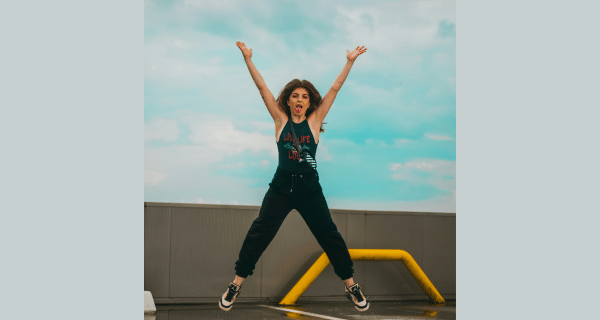

A star jump like this is the exact shape at the heart of the Toyota v Jetstar trade mark dispute.” (Photo by Elvis Kaiser on Unsplash)
When a Gesture Becomes a Brand Asset
Most businesses understand that a name, logo or slogan may be registered as a trade mark. But some of the world’s most recognisable branding does not involve words at all. It involves a movement, a pose or a gesture.
Think of Toyota’s famous “Oh, What a Feeling!” jump. Usain Bolt’s lightning pose. Michael Jordan’s Jumpman silhouette. Kylian Mbappé standing with his arms crossed. These movements can become so closely associated with a person or brand that seeing the gesture alone may be enough to make the connection.
This raises a fascinating question for Australian trade mark law: can you trade mark a movement, gesture or signature pose?
The answer is not straightforward. Australian law potentially allows movement trade marks, but registration — and the scope of any resulting monopoly — can depend upon how the movement is represented, how distinctive it is, how it has been marketed and, importantly, what consumers understand the movement to mean.
A trade mark does not have to be a word or logo
The starting point is the Trade Marks Act 1995 (Cth).
A trade mark is a “sign” used, or intended to be used, to distinguish one trader’s goods or services from those of other traders (Trade Marks Act 1995 (Cth), s 17). The definition of “sign” is deliberately broad and includes words, names, devices, brands, shapes, colours, sounds and scents (Trade Marks Act 1995 (Cth), s 6).
Australian trade mark practice also recognises moving images and gestures as potential trade marks. IP Australia identifies movement marks as a form of non-traditional trade mark and has used Toyota’s famous advertising jump as an example.
However, the fact that something can constitute a trade mark does not mean that it will necessarily be accepted for registration.
The difficult question is often whether the movement is functioning as a trade mark at all. Is a consumer seeing a badge of commercial origin, or simply watching somebody jump, dance, celebrate or pose?
Toyota, Jetstar and the battle of the jumps
Australia has already provided an excellent illustration of just how complicated this can become.
Toyota had used its famous jumping imagery in connection with the “Oh, What a Feeling!” advertising campaign for decades. It subsequently sought trade mark protection for different versions of its jump, including movement marks. This ultimately brought Toyota into conflict with Qantas and its Jetstar brand over competing jumping imagery.
Remarkably, the dispute came down in part to the mechanics of the jump — including whether the legs were bent or straight and the positioning of the arms and legs. What might look like a tiny creative difference to a marketing team can become legally significant when the precise scope of a movement trade mark is being considered.

Toyota’s brand — and its famous jump — have both become valuable intellectual property assets.” (Photo by Shrawan Choudhary on Unsplash)
Is the movement distinctive enough?
One of the central hurdles is distinctiveness.
Section 41 of the Trade Marks Act 1995 (Cth) concerns whether a proposed trade mark is capable of distinguishing the applicant’s goods or services. The High Court considered the concept of distinctiveness in Cantarella Bros Pty Limited v Modena Trading Pty Limited (2014) 254 CLR 337; [2014] HCA 48, including the significance of a sign’s ordinary meaning and whether other traders might legitimately wish to use it.
The Court referred to avoiding the “impairment of the rights of honest traders” (Cantarella Bros Pty Limited v Modena Trading Pty Limited (2014) 254 CLR 337; [2014] HCA 48 at [59]).
Applied to a movement, that can become a difficult exercise.
A highly unusual sequence of movements consistently used by one business may be easier to distinguish from ordinary human movements. A conventional jump, hand gesture or celebratory pose may present a very different case.
The law is therefore highly fact dependent.
Your marketing may affect your trade mark rights
There is another aspect of movement trade marks that businesses sometimes overlook: marketing strategy can become part of trade mark strategy.
Where a proposed trade mark is not sufficiently inherently distinctive, evidence of use may become important under s 41 of the Trade Marks Act 1995 (Cth). Depending upon the circumstances, evidence may include the length and extent of use, advertising expenditure, sales and turnover, geographical use and evidence concerning consumer recognition.
More importantly, it may matter how the movement has been used.
Suppose an athlete performs a particular gesture occasionally after winning. That may be regarded simply as a celebration. But suppose the same gesture is deliberately and consistently used across merchandise, advertising, sponsorship campaigns and promotional material in a manner designed to identify that athlete’s commercial brand.
The legal position may look quite different.
This is why businesses should ideally consider trade mark protection while developing their branding rather than only after a campaign has become successful. The way a marketing agency presents a movement today may affect the evidence available to support a trade mark application tomorrow.
What exactly are you trying to own?
This is perhaps the most interesting practical problem.
It is not enough to say, “I want to trade mark my move.”
A movement trade mark needs to be represented with sufficient precision so that other traders can understand what has been claimed. IP Australia has specific requirements concerning moving images and gesture marks, including appropriate representations and descriptions of the movement.
This can create a strategic tension.
Define the movement very narrowly and another trader may potentially create something sufficiently different to avoid the registered right. Try to claim the concept too broadly and the application may encounter objections concerning distinctiveness, clarity or the legitimate rights of other traders.
Getting the application right can therefore involve both legal and commercial judgment.
What happens when AI copies the move?
Generative AI adds another layer of uncertainty.
Imagine an AI-generated advertisement depicting a fictional athlete performing something very close to a famous signature pose. The face is different. The clothing is different. The background is different. Perhaps the position of one arm or leg has also been changed.
No photograph has necessarily been copied.
But has the movement trade mark been infringed?
Trade mark infringement under s 120 of the Trade Marks Act 1995 (Cth) can arise where a person uses as a trade mark a sign that is substantially identical with, or deceptively similar to, a registered trade mark in circumstances covered by the section.
For movement marks, AI may increasingly test where similarity ends and imitation begins.
It also exposes a broader gap in Australian law. Unlike some jurisdictions, Australia does not have a general standalone personality or publicity right giving a celebrity ownership over every commercial use of their image, likeness or persona.
Depending upon the circumstances, protection may instead involve a combination of trade mark law, copyright, passing off and misleading or deceptive conduct under s 18 of the Australian Consumer Law (Sch 2 to the Competition and Consumer Act 2010 (Cth)).
The well-known decision in Pacific Dunlop Ltd v Hogan (1989) 23 FCR 553; [1989] FCA 185 illustrates how Australian law may respond where advertising appropriates a highly recognisable persona. Burchett J referred to consumers wanting something “belonging in some sense to Crocodile Dundee”.
AI now makes that issue considerably more complicated.
Turning a movement into an asset
A gesture may begin spontaneously. A jump after a victory. A particular pose. A hand movement in a video. A few seconds at the end of an advertising campaign.
With repetition, however, it may acquire considerable commercial value.
That is when businesses, athletes, performers and influencers should consider whether what they have created is simply a memorable moment — or potentially an intellectual property asset.
There is no automatic right to “own” a movement simply because it is original, famous or associated with a particular person. The strength of any trade mark application can depend upon the precise movement claimed, the goods and services covered, how consumers perceive it, the history of its use and the quality of the evidence supporting the application.
The timing and nature of the marketing campaign itself may also influence the legal position.
At Sharon Givoni Consulting, we help businesses and creators identify what aspects of their branding may be protectable, assess the prospects of trade mark registration, develop filing strategies and consider the evidence needed to establish distinctiveness.
Because sometimes turning an idea into an asset begins with recognising that the valuable part of your brand may not be its name. It may be the move everyone remembers.
Movement can be a trade mark: Australian trade mark practice recognises movement and gesture marks, subject to the ordinary requirements for registration.
Toyota really did trade mark jumps: Toyota sought Australian protection for different versions of its famous “Oh, What a Feeling!” jumping imagery.
Small differences can matter: Bent legs, straight legs and the positioning of arms can potentially become important when defining and comparing movement marks.
Trade marks can appeal to other senses: The definition of “sign” under s 6 of the Trade Marks Act 1995 (Cth) includes such things as shapes, colours, sounds and scents.
Famous does not automatically mean registrable: A movement still needs to satisfy the requirements of Australian trade mark law, including the requirements concerning distinctiveness (Trade Marks Act 1995 (Cth), s 41).
Marketing can become evidence: Advertising, sales, length of use and the way consumers have been exposed to a mark may become important when attempting to establish acquired distinctiveness.
Australia has no general celebrity ownership right: There is no standalone Australian personality or publicity right that simply gives a famous person ownership of every commercial use of their persona.
And AI has made the question harder: A computer can now imitate a recognisable movement without necessarily reproducing the photograph or video that originally made it famous.
Laws referred to in this article
- Trade Marks Act 1995 (Cth) — ss 6, 17, 41, 120
- Australian Consumer Law, Schedule 2 to the Competition and Consumer Act 2010 (Cth) — s 18
- Cantarella Bros Pty Limited v Modena Trading Pty Limited (2014) 254 CLR 337; HCA 48
- Pacific Dunlop Ltd v Hogan (1989) 23 FCR 553; FCA 185
Further Reading
The Branded Banana: How Wax-Tipped Bananas Became Trade Marks — Sharon Givoni Consulting
https://sharongivoni.com.au/the-branded-banana-how-wax-tipped-bananas-became-trade-marks//
Why Are Colour Trade Marks Difficult to Obtain? — Sharon Givoni Consulting
https://sharongivoni.com.au/colour-by-numbers-how-whiskas-cadbury-and-milka-turned-purple-and-lilac-into-trade-marks/
Can AI-Generated Brands Break the Law in Australia? — Sharon Givoni Consulting
https://sharongivoni.com.au/how-far-can-you-take-creative-claims/
AI-Generated Brand Names and Logos: Who Owns Them in Australia? — Sharon Givoni Consulting
https://sharongivoni.com.au/can-ai-really-create-a-brand-for-you/
Kinds of Trade Marks — IP Australia (Australian Government)
https://www.ipaustralia.gov.au/trade-marks/what-are-trade-marks/kinds-of-trade-marks
An Empirical Investigation of 20 Years of Trade Mark Infringement Litigation in Australian Courts — Vicki T Huang, Sydney Law Review (2019) 41(1), 105–130
https://www.sydney.edu.au/content/dam/corporate/documents/sydney-law-school/research/publications/slr-march-2019-vol-41-no-1.pdf

A signature pose can become instantly recognisable — but does that make it a trade mark?” (Photo by Vultar Bahr on Unsplash)
Please note the above article is general in nature and does not constitute legal advice.
Please email us info@iplegal.com.au if you need legal advice about your brand or another legal matter in this area generally.