






Used under a Creative Commons Licence
The Branded Banana: How Wax‑Tipped Bananas Became Trade Marks
If you’ve ever spotted a bunch of bananas with a bright red tip and wondered what on earth is going on, you’ve already met one of Australia’s most interesting non‑traditional trade marks. Those red‑tipped bananas aren’t a gimmick; they’re a clever mix of eco‑farming, brand strategy and trade mark law that shows just how powerful a distinctive product feature can be when you treat it as intellectual property rather than “just design.”
Queensland farmers Frank and Dianne Sciacca had a classic marketing problem: how do you get time‑poor supermarket shoppers to notice that your bananas are different? Their fruit is grown under the Ecoganic system, with minimal chemicals, healthier soil and better outcomes for biodiversity and the reef. That’s a big story to squeeze onto a tiny sticker that most people never read. Shoppers race through the fresh‑produce aisle on autopilot. The Sciaccas needed a simple, instant visual cue that said, “These bananas are not like the others” – from a distance, in seconds.
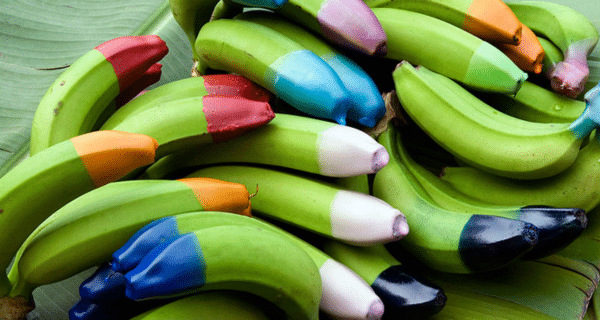
Frank’s solution was disarmingly simple. He dipped the very tips of the bananas in coloured food‑grade wax so only the end of each banana was coated, creating a bold band of colour against the yellow peel. Suddenly the fruit jumped off the shelf. The red wax tip was visible from across the aisle and quickly became a talking point. As the Ecoganic range expanded, so did the palette: today Pacific Coast Eco Bananas use red, pink, green and blue tips across bananas, avocados and papayas to signal their certified Ecoganic farming system. One glance at the end of the fruit tells shoppers they’re looking at something with a specific story and standard behind it.
The really interesting part, from a legal and brand‑strategy perspective, is what happened next. The Sciaccas didn’t treat the wax tip as a fun one‑off. Through their company Fada Pty Ltd, they moved to protect the wax‑tipped banana as a registered trade mark in Australia. They started with the red tip and then secured broader registrations covering an opaque coloured coating applied to one end of a banana, and related brand elements. Over time they built a small “trade mark family” around the concept: multiple registrations, several specifically for coloured wax tips on bananas and others covering variations and associated get‑up.
That is not an automatic process. To get these banana trade marks registered, they had to show that the appearance itself – the coloured wax tip on the banana – functioned as a badge of origin. In plain language, they needed to persuade the authorities that when people saw that wax‑tipped banana, they thought of one trader, not just “any banana with a bit of colour.” Doing that required detailed evidence: sales figures showing commercial impact, marketing materials tying the wax tip to the Ecoganic message, declarations from people in the fruit and veg industry, and years of educating consumers to “look for the distinctive red tip” as the sign of Ecoganic bananas. The more consistently they used the wax tip in advertising, packaging, point‑of‑sale and online, the stronger the association became between that visual feature and their business.
The legal value of that strategy became very clear when a competitor tried to move into the same visual territory, using a purple wax tip on bananas and attempting to register his own colour‑tipped banana mark. The owners of the Ecoganic brand took action in the Federal Court for trade mark infringement. The Court agreed that the wax‑tipped get‑up was not just decoration – it was protected intellectual property. Orders were made requiring the competitor to stop using visible opaque wax coatings on one end of bananas, withdraw his application and pay damages and costs. In other words, the red‑tip idea that started in a packing shed ended up enforceable in a courtroom.
Today, the coloured wax tip sits at the centre of the Ecoganic brand story. It appears on bananas, avocados and papayas, in the logo, across the website and in point‑of‑sale materials. It links sustainable farming practices, shelf impact and legal protection in one simple visual hook. For brand owners, particularly in food and agribusiness, it’s a textbook example of how a small, distinctive product feature – a colour, a shape, a band, a cut‑out – can become a valuable, enforceable Australian trade mark when you use it consistently and support it with the right kind of evidence.
From an SEO and practical point of view, the key lesson is this: don’t underestimate the branding power of your product’s “little quirks.” If you have:
- A unique colour treatment on your packaging or product
- A particular feature on your goods (like a tip, band, window, embossing or shape)
- A consistent visual cue that customers look for before they even read your name
then you may already be sitting on a potential non‑traditional trade mark. The right legal and branding strategy can turn that feature into something you not only build your marketing around, but also own and enforce. For many businesses, it’s worth asking: what is my “wax‑tipped banana” – and am I protecting it, or leaving it for someone else to copy?
The Branded Banana: How Wax‑Tipped Bananas Became Trade Marks
The red wax is food‑grade and safe to eat (though most people peel it off).
The tip only covers a small section of the banana – the rest is uncoated.
Each wax colour is linked to Ecoganic certification and farming practices.
The first wax‑tipped bananas hit Australian supermarket shelves around 2000.
The red tip was designed to be visible from a distance in the banana section.
Pacific Coast now uses wax tips on bananas, avocados and papayas.
The wax tip appears in the company’s logo and brand materials.
Fada Pty Ltd and related entities hold multiple trade mark registrations for the tip.
A rival grower’s purple‑tipped bananas were stopped after Federal Court action.
The brand promotes the tip as a quick shopper shortcut to Ecoganic produce
Today, the coloured wax tip sits at the centre of the Ecoganic brand story. It appears on bananas, avocados and papayas, in the logo, across the website and in point‑of‑sale materials. It links sustainable farming practices, shelf impact and legal protection in one simple visual hook. For brand owners, particularly in food and agribusiness, it’s a textbook example of how a small, distinctive product feature – a colour, a shape, a band, a cut‑out – can become a valuable, enforceable Australian trade mark when you use it consistently and support it with the right kind of evidence.
Before you rush off to “paint” your own product with a new colour, shape or feature, it’s worth remembering that not every clever idea will qualify as a trade mark. The law only protects features that actually tell consumers where the product comes from, not those that are purely decorative or common in your industry. The real magic happens when design, marketing and legal strategy work together so that customers learn to rely on a particular look as a shortcut for your brand.
If you think you already have something like that – a distinctive band, dip, cut‑out, texture, bottle shape or colour scheme that people recognise before they even see your name – it may be time to treat it as more than “just design.” With the right use and protection strategy, those small details can become some of your most valuable business assets, helping you stand out on the shelf and keeping copycats at bay.
Interesting facts about red‑tipped bananas
- Find your “signature” feature.
- Use it the same way everywhere.
- Avoid colours or shapes everyone uses.
- Save proof of how long you’ve used it.
- Tell customers to “look for” that feature.
- Check if competitors use anything similar.
- Protect names, logos, shapes and colours together.
- Describe the feature very clearly when filing.
- Be ready to show it points to your brand.
- Always get proper legal advice before you act.
Further reading – articles by Sharon Givoni
Protecting What’s Special
https://sharongivoni.com.au/protecting-whats-special/
Protect Your Business Idea and Stop Others from Copying
https://sharongivoni.com.au/first-to-market-heres-how-to-stop-others-from-copying-your-idea/
Laws of Photography in Public Spaces
https://sharongivoni.com.au/laws-of-photography-in-public-spaces/
Branding Laws Packaged and Gift‑Wrapped
https://sharongivoni.com.au/wp-content/uploads/2025/06/Branding-laws-packaged-and-gift-wrapped-Reed-Gift-Fairs.pdf/
Small Design, Serious Risk: Favicon Trade Mark Confusion Explained
https://sharongivoni.com.au/small-design-serious-risk-favicon-trade-mark-confusion-explained/
Further reading – non‑law / non‑law‑firm pieces
Australian Wax Tip Eco‑Bananas
https://verdemode.com/australian-wax-tip-eco-bananas/
Ecoganic Red Tip Bananas Paving the Way for Sustainable Farming
https://pipmagazine.com.au/ecoganic-red-tip-bananas/
Seeing red‑tipped bananas in the supermarket? Here’s why
https://business.nab.com.au/seeing-red-tipped-bananas-in-the-supermarket-heres-why
Please note the above article is general in nature and does not constitute legal advice.
Please email us info@iplegal.com.au if you need legal advice about your brand or another legal matter in this area generally.