





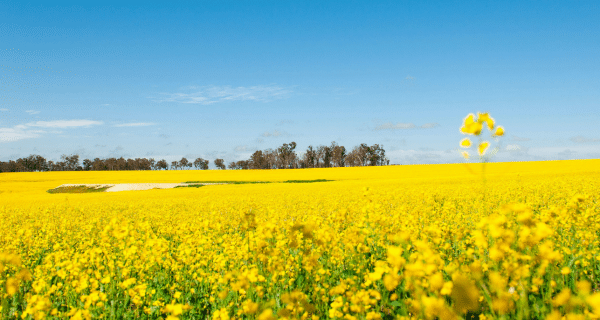

Canola fields make a popular Instagram background – fields of gold – but how legal is this practise?
Fields of Gold or Legal Minefield? Canola Photos, Trespass and the Law
What photographers, influencers and travellers need to know before stepping into that yellow paddock
I used to think of canola as something that lived only in the pantry and in policy papers – a neutral, pale oil, often mentioned in the same breath as “GM”, labelling battles and food law debates. In my head it was a commodity, not a landscape. If you’d asked me a few years ago what a canola plant looked like, I probably would have said, “Something yellow in a paddock somewhere,” and left it at that.
Then you open Instagram.
On social media, canola isn’t an ingredient or a crop; it’s a colour palette and a backdrop. Those same plants I’d only ever met in regulations suddenly become “fields of gold” and “yellow heaven”. You scroll and see people leaping in oceans of flowers, couples framed by endless yellow, influencers twirling in dresses that look designed to match the petals. In that universe, canola doesn’t start life as a seed in a grower’s budget; it starts life as “content” in someone’s feed.
For people who live online, everything becomes an image. A paddock becomes a location. Someone’s workplace becomes a shoot. A farmer’s annual income becomes “that spot we stopped at on the way to brunch”. You see the post, not the property line. You see the likes, not the liability. And if all you’ve ever known of canola is a bottle on a supermarket shelf and a trending reel, it’s very easy not to see the problem at all.
But there is a problem, and it’s not just about good manners. Once you step away from the screen and into the real paddock, the law comes with you. That “perfect shot” might be on the wrong side of a fence. That dreamy walk through the flowers might be clear‑cut trespass. The footprints you leave in the crop can translate into real financial loss for the person who grew it. The soil or seeds on your shoes and tyres can carry biosecurity risks the farmer will be dealing with long after your story expires.
As a lawyer, my day job is thinking about where rights begin and end – who owns what, who bears which risks, and what happens when well‑meaning people cross invisible lines. With canola, there’s a collision between an image‑hungry online culture and very old‑fashioned legal ideas like private property, trespass and duty of care. The flowers are new to Instagram; the law around them is not.
Why read this article?
This article is for photographers, influencers, content creators, travellers and tourism operators – as well as farmers and regional businesses – who want to understand, in plain English, where the legal boundaries sit around canola photography. It’s not about scaring people away from the countryside or drowning you in legislation. Instead, it explains the real‑world issues we see in practice and the questions you should be asking before you step into that yellow field or book that “canola shoot”.
At Sharon Givoni Consulting, we’re increasingly asked to advise on:
- people entering paddocks without permission for photos;
- tour operators and photographers wanting to use farms as locations;
- influencers posting images from questionable locations;
- landowners unsure how far they can go in stopping unwanted photography.
By unpacking the canola story, this article helps you spot the legal and practical risks early, ask better questions, and know when it’s time to get tailored advice.
Trespass: when a photo crosses the line
At the heart of the canola issue is a simple concept: trespass. In legal terms, trespass to land is entering or remaining on someone else’s property without consent. There does not need to be a smashed fence or a fist‑fight. Quietly walking into a paddock “just for a quick photo” can be enough.
Important points to understand:
- Fences, gates and signs matter: climbing a fence, ducking under a wire or going through a gate you were not invited to use strongly suggests you know you’re crossing a boundary.
- “No damage” is not a defence: the landowner does not need to prove you physically damaged the crop for it to be trespass. The wrong is simply being there without permission.
- Civil and, sometimes, criminal consequences: in some situations, entering enclosed lands without consent, interfering with stock or damaging crops can amount to criminal offences as well as civil trespass.
- For photographers and influencers, the practical rule is: if you are not sure who owns the land, or you have not clearly been given permission to enter it, you should assume you cannot walk into the crop.
Biosecurity and safety: more than just etiquette
Alongside trespass, canola fields raise biosecurity and safety concerns. Farmers manage serious risks around weeds, pests and diseases. Mud and plant material on your shoes, clothing and vehicle can move those problems from one farm to another. There may also be recent spraying with chemicals that are not meant for casual visitors.
On the safety side, popular canola spots often sit on narrow or fast roads. People stopping suddenly, parking partly on the road, or walking along the bitumen for “the shot” create obvious hazards. If an accident occurs, questions can arise about who owed a duty of care and whether that was breached – drivers, visitors, and sometimes landowners or tour operators.
When we advise in this space, we are not just looking at trespass, but also:
- potential breaches of biosecurity obligations;
- occupiers’ liability and duty of care owed to visitors;
- how marketing and social‑media promotions may encourage risky behaviour.
Public vs private: why “if I can see it, I can shoot it” is wrong
One of the most persistent myths we come across is: “If I can see it from where I’m standing, I can photograph it.” There is some truth in that – if you are standing on public land, you can usually photograph what you can see from there, including a distant canola field.
The trouble starts when people turn that into “I can go wherever I like to improve my angle.” You can rarely change your legal rights by moving yourself onto someone else’s land. A public road is not a free pass to walk into the paddock next to it.
This “public versus private” confusion also appears in urban settings:
- shopping centres that feel public, but are privately controlled and can restrict photography;
- train stations, stadiums and venues where conditions of entry quietly regulate filming and image use;
- privately owned plazas and waterfronts designed to look like civic squares but subject to owner rules.
What unites canola fields and these city spaces is that how a place feels is not the same as how the law treats it.
How this plays out for our clients
We see the canola issue from multiple angles:
- Photographers and influencers wanting to know what they can safely do, and how to manage location permissions, model releases and contracts with clients.
- Tourism and events businesses planning experiences around “Instagrammable” rural locations and needing to structure access and permissions properly.
- Landowners and local councils wanting to protect crops and manage visitor numbers without killing off tourism entirely.
- Brands and agencies commissioning campaigns in rural settings and needing to be confident they are not building advertising collateral on unlawful shoots.
The legal issues here don’t sit in a single box. Trespass, biosecurity, negligence, contract, privacy, even defamation and consumer law can all be in the mix depending on what is shot, how it is used, and what is said about it.
How Sharon Givoni Consulting can help
We regularly help clients navigate the legal side of photography, locations and online content. In the canola context and beyond, we can:
- Review and advise on shoot plans – including location access, permits, consents and risk areas.
- Draft or negotiate location agreements between landowners, photographers, influencers and brands.
- Prepare clear terms and policies for businesses running tours, workshops or events involving “photo‑friendly” locations.
- Advise on image use and social media, including what you can safely post, how to handle takedown requests, and how to respond if someone misuses your images.
- Support landowners who want to set sensible rules for photography on their property and respond appropriately to unwanted access.
Every situation is different. A solo content creator doing a small personal shoot will have different needs and risks to a national tourism campaign or a large influencer collaboration. Our role is to help you understand where you stand, reduce legal risk and keep as much of the creative freedom as possible.
If you’re planning a canola shoot, developing tourism around rural “photo spots”, or just want to make sure your content practices are legally sound, it is worth getting advice before there is a problem, not after.
Tricky photo backdrops that can cause legal issues
- Shopping centers and malls – Private property; owners can ban or limit photography and ask you to leave.
- Markets and street‑art laneways – Access, stallholder rights and mural copyright can all be issues for photo shoots.
- Train stations and platforms – Controlled areas; casual snaps are often okay, but commercial or staged shoots may need approval.
- Stadiums and concert venues – Ticket terms often restrict “professional” photos and video, even for social media.
- Privately owned plazas and waterfronts – Look public, but filming can be controlled by the landowner or body corporate.
- Beaches and pools – Public spaces, but close‑up or persistent photos of people (especially kids) can raise privacy and harassment concerns.
Further reading
Laws of Photography in Public Spaces
https://sharongivoni.com.au/laws-of-photography-in-public-spaces/
Can I Be Sued for Taking Someone’s Photo?
https://sharongivoni.com.au/can-i-be-sued-for-taking-someones-photo/
They Stole My Photo! – Copyright Theft
https://sharongivoni.com.au/they-stole-my-photo-copyright-theft/
What Australia’s New Privacy Tort Means for Artists, Photographers and Creatives
https://sharongivoni.com.au/privacy-law-for-artists/
Please note the above article is general in nature and does not constitute legal advice.
Please email us info@iplegal.com.au if you need legal advice about your brand or another legal matter in this area generally.