






How Do You Know When You’ve Copied Too Much?
There is no magic percentage in copyright law. A famous Aboriginal art case and the Cotton On litigation show why what you copy can matter far more than how much.
One of the most persistent myths I hear about copyright is this: “As long as I change 10%, I’m okay.” Sometimes it becomes 20%. Sometimes people tell me they have been advised that they only need to make a design “30% different.” Unfortunately, copyright law does not come with a mathematical formula. There is no general rule under Australian copyright law that allows you to copy 10% of somebody else’s work, and there is no rule that says changing a work by 10%, 20% or any other percentage will prevent infringement. So if there is no percentage, how do you know when you have copied too much? That is where the concept of a “substantial part” comes in.
HOW CAN A COPYRIGHT LAWYER HELP?
Copyright infringement is not simply about how similar two works look. An experienced copyright lawyer knows the cases and legal tests and can assess whether what has been copied is legally significant.
They can help you avoid problems before launch, respond to a copyright claim, stop someone copying your work or negotiate a resolution.
Don’t rely on a percentage you have heard online or try to work it out alone. Getting advice early can save considerable time, money and trouble later.
What does “substantial” actually mean?
Under the Copyright Act 1968 (Cth), you do not have to copy an entire copyright work to infringe it. Section 14(1) of the Act provides that a reference to doing an act in relation to a substantial part of a work is to be treated as a reference to doing that act in relation to the whole work — meaning reproducing a substantial part, for the purposes of the exclusive reproduction right in section 31 and the infringement provisions in section 36, can be just as unlawful as reproducing everything. The confusing part, though, is that “substantial” does not necessarily mean large. Australian courts approach the question primarily as one of quality rather than quantity. In Elwood Clothing Pty Ltd v Cotton On Clothing Pty Ltd 2008 FCAFC 197, the Full Federal Court described the substantial-part inquiry as “a qualitative, not a quantitative question.” The Court’s focus was on whether Cotton On had reproduced what made Elwood’s designs original artistic works — not what mathematical percentage of each design had been copied. That distinction is the key to understanding the supposed 10% rule.
The carpet case: when 5–10% was enough
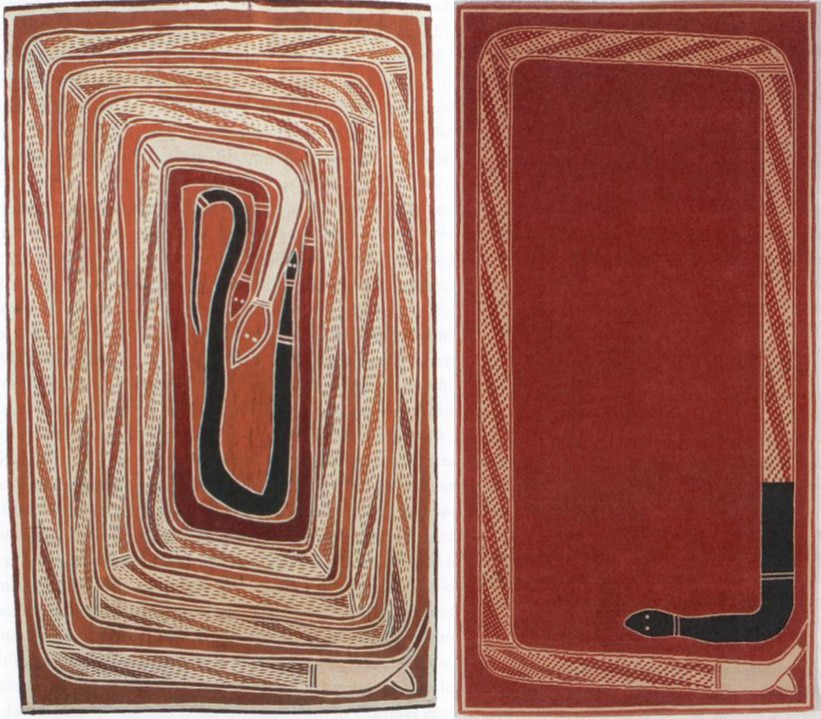
Perhaps the best illustration is Milpurrurru v Indofurn Pty Ltd (1994) 54 FCR 240, the well-known Aboriginal carpets case. The proceedings concerned Aboriginal artworks that had been reproduced, without permission, on carpets manufactured overseas and then imported into Australia for sale — conduct that engaged not only the reproduction right in section 31 but also the importation infringement provisions in section 37 of the Copyright Act 1968 (Cth). One particular carpet is a wonderfully visual demonstration of how copyright law works.

Original Aboriginal artwork (left) and the carpet (right). In Milpurrurru v Indofurn Pty Ltd (1994) 54 FCR 240, the copied border represented only around 5–10% of the original artwork but was held to be a substantial part.
Look at the two images. The carpet did not reproduce 90% of the artwork, and it did not reproduce half of it either. In fact, the unusual border pattern it took came from a portion comprising “not more than 5–10% of the artwork.” Yet the Court found the copying substantial. Why? Because although the amount taken was relatively small, its creative significance was not. The Court explained that “in a qualitative sense the copying is substantial,” noting that the pattern taken from the artwork had become the “striking feature of the carpet.” That is probably the clearest answer to anyone who says, “But I only copied 10%.” Ten per cent of what? If it is an insignificant background detail, that is one thing. If it is the distinctive and original feature that gives the work much of its character, that may be quite another.
Sometimes even 5–10% can be enough
A “substantial part” does not mean that someone must have copied most of a work. The courts look at the quality and importance of what has been taken, rather than simply measuring its size. As the Full Federal Court has explained, even a quantitatively small part may be substantial where it is a “vital or material part” of the original work (Dixon Investments Pty Ltd v Hall (1990) 18 IPR 490 at 494 (Lockhart, Spender and Ryan JJ)). The point is illustrated particularly well by Milpurrurru v Indofurn Pty Ltd (1994) 54 FCR 240, where a distinctive border representing only about 5–10% of the original Aboriginal artwork was nevertheless held to be a substantial part. In other words, 5–10% was not a safe zone.
Cotton On: changing the details wasn’t enough
On the same theme, Elwood Clothing Pty Ltd v Cotton On Clothing Pty Ltd 2008 FCAFC 197 gives us another useful example — this time involving fashion rather than fine art. Elwood’s case concerned artwork used on a T-shirt and swing tag. Cotton On’s designers had been directed to use Elwood’s designs as a reference and create products with the same “look and feel, yet different.” And Cotton On certainly changed things: it did not use all the same words and numbers. But that did not ultimately save it. The Full Court found that Cotton On had reproduced the layout, positioning of elements, aspects of the font, overall pattern and “look and feel” of the Elwood designs, contrary to the reproduction right protected by section 31 and enforced through section 36 of the Act. In reaching that conclusion, the Court looked at what made Elwood’s design an original artistic work in the first place — much of the creative effort had gone into matters such as the curved sections, letter forms, overall V shape, balance of elements and their proportions. Its conclusion is particularly useful: “Even though the logo and numbers were different, by taking the layout and other elements of expression that created the desired ‘look and feel’, Cotton On took a substantial part of the copyright work.” In other words, the exercise is not simply to put the two works next to each other and count the differences.


Elwood’s NewDeal T-shirt (above) and Cotton On’s Moscow and Kingston T-shirts (below). The Full Federal Court found that Cotton On had taken a substantial part of Elwood’s artistic work despite differences in the words, numbers and logos: Elwood Clothing Pty Ltd v Cotton On Clothing Pty Ltd [2008] FCAFC 197.
The question is the importance of the material taken to the original copyright work, not how much space it occupies in the new work. As the Court put it: “There may be a taking of a substantial part even if the overall appearance of the alleged infringing work is very different from the work in which copyright subsists.” (EMI Songs Australia Pty Ltd v Larrikin Music Publishing Pty Ltd [2011] FCAFC 47 at [53] (Emmett J), citing Designers Guild Ltd v Russell Williams (Textiles) Ltd [2000] 1 WLR 2416).
That is why the supposed 10% rule is so misleading. Copyright is not a mathematical exercise. A small but distinctive, memorable or creatively important part of a work can matter far more than its percentage suggests.
So how do you know?
Leaving percentages aside altogether, there is no single checklist that produces an automatic answer, but a handful of questions get you much closer to the truth than “Have I changed 10%?” It helps to ask what you have actually taken from the original work, how original or distinctive that part is, and how important it is to the work as a whole.
It is also worth asking whether you are taking the creator’s particular expression rather than merely an idea, whether you independently created your own work or had the original in front of you, and whether you have simply changed superficial details while retaining the important creative features.
That is much closer to the way a court actually approaches the issue. In Elwood v Cotton On, for instance, the Full Court said that what made the designs original was the combination of their artistic elements, and the fact that Cotton On changed some individual elements did not answer the real question.
Forget the calculator
Building on all of this, the practical message is surprisingly simple. If you are designing a garment, illustration, website, photograph, piece of packaging, textile print, artwork or other creative material, don’t ask your designer to “change it by 20%.” And don’t assume that taking only a small part makes you safe — the carpet in Milpurrurru shows exactly why: 5–10% was enough because what was taken mattered. Elwood v Cotton On takes the principle further still, since changing obvious details such as words, numbers and logos did not prevent infringement where what remained was a substantial part of the original artistic expression under section 31 and section 36 of the Copyright Act 1968 (Cth); the Full Court ultimately allowed Elwood’s appeal and declared that Cotton On had infringed copyright. Perhaps, in the end, the easiest way to remember it is this: copyright isn’t a percentages game. The question isn’t simply how much you took — it’s what you took.
Further Reading
Copyright Myths That Refuse to Die — particularly relevant because it deals directly with the supposed “10 per cent rule” and other common copyright misconceptions.
https://sharongivoni.com.au/copyright-myths-that-refuse-to-die/?utm_source=chatgpt.com
Copyright: A Basic Guide for Designers in Australia — explains substantial reproduction, the 10% myth and what designers need to know before using other people’s
https://sharongivoni.com.au/copyright-and-wrong-a-basic-guide-for-designers/?utm_source=chatgpt.com
Protecting Textile Patterns and Designs — particularly relevant to artistic works, patterns and the misconception that changing 10% of a design avoids infringement.
https://sharongivoni.com.au/protecting-textile-patterns-and-designs/?utm_source=chatgpt.com
Inspiration… or Rip Off? When Does Inspiration Become Copying in Branding, Packaging and Product Design? — looks at where inspiration ends and unlawful copying can begin.
https://sharongivoni.com.au/inspiration-or-rip-off/?utm_source=chatgpt.com
Legal Protection of Indigenous Culture in Australia — Justice Ronald Sackville, Federal Court of Australia — includes a particularly useful discussion of Milpurrurru v Indofurn and notes that infringement was found even where no more than 10% of an artwork was used to create the carpet’s border.
https://classic.austlii.edu.au/au/journals/FedJSchol/2002/1.html?utm_source=chatgpt.com
Milpurrurru & Ors v Indofurn & Ors: Protecting Expressions of Aboriginal Folklore Under Copyright Law — Michael Blakeney, Murdoch University Electronic Journal of Law — useful background on the carpet case, the artworks and the broader significance of protecting Indigenous artistic expression.
https://www5.austlii.edu.au/au/journals/MurdochUeJlLaw/1995/4.html?utm_source=chatgpt.com
Please note the above article is general in nature and does not constitute legal advice.
Please email us info@iplegal.com.au if you need legal advice about your brand or another legal matter in this area generally.