





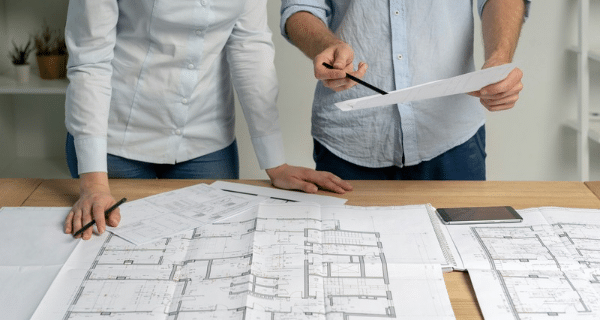

Photo by Getty Images on Unsplash
Turning Legalese into Legal Ease(R)
WHO DOES THIS APPLY TO?
This article is for:
- homeowners who have paid an architect or building designer to draw house plans;
- people who want to take their plans to a different builder;
- anyone planning to renovate, extend or reuse an existing house design;
- architects, building designers and builders who prepare or supply plans; and
- property developers who commission designs for homes.
You paid for the plans. So what’s the problem?
Imagine spending thousands of dollars having your dream home designed.
You’ve sat through meetings, talked through the kitchen layout, moved the laundry three times and debated whether the second bathroom really needs a bath.
Finally, the architect hands over the plans and you pay the last invoice.
They’re yours, right?
Well, not necessarily.
Under Australian law, owning a copy of the plans and owning the copyright in the plans are two different things.
That difference really matters when a building project doesn’t go to plan. Perhaps you’ve fallen out with your architect. Your builder has put the price up. You’ve decided to use another building company. Or you simply want to build the same house on a different block.
Suddenly, who owns the copyright is no longer just a legal technicality.

Changing builders? Check what your permission to use the plans actually covers. | Photo by Amsterdam City from unsplash
Owning the plans versus owning the copyright
Think about buying a book.
You own the book. You can read it, lend it to a friend or put it on your shelf.
But buying the book doesn’t give you the copyright in the story. You can’t print copies and sell them.
House plans work in a similar way.
Under the Copyright Act 1968 (Cth), house plans are protected as “drawings”, which are a type of artistic work, and buildings are protected as artistic works too (section 10(1)). Copyright applies automatically to original works. You don’t need to register it (section 32).
The copyright owner has the exclusive right to copy the work (section 31). And copyright goes beyond the paper. Building a house from a plan can count as copying the plan (section 21(3)).
In other words, copyright isn’t only about photocopying a plan. It also applies when someone uses a plan to build a house.
So who owns the copyright?
Usually, the architect or building designer who drew the plans owns the copyright (section 35).
There is an important exception for employees. If a draftsperson draws plans as part of their job, their employer usually owns the copyright, unless they have agreed otherwise (section 35(6)).
But simply paying an independent architect or designer to draw your home does not make you the copyright owner. The Copyright Act has a special rule giving copyright to people who commission certain works, such as some photos and portraits, but it doesn’t apply to house plans.
That’s why your written agreement matters so much. It might say:
- the architect keeps the copyright;
- the copyright is transferred to you; or
- the architect keeps the copyright but gives you permission to use the plans for a particular purpose.
These options lead to very different results. If copyright is transferred to you, the transfer must be in writing and signed by the architect (section 196(3)).

A few changes don’t necessarily make a design your own. | Photo by Curated Lifestyle from unsplash
What if the contract says nothing about copyright?
This is where it gets more complicated.
Even if the architect keeps the copyright, you may still have a licence, which simply means permission, to use the plans.
That permission might be written into your agreement. But even if it isn’t, the law may treat it as having been given, because of why the plans were drawn and how you and the architect dealt with each other. This is called an “implied licence”.
Courts have recognised this for a long time. In a well-known English case, Blair v Osborne & Tomkins [1971] 2 QB 78, the court held that a landowner who paid an architect’s normal fee for plans for a particular site had permission to use them to build on that site. Australia’s highest court relied on that principle in Concrete Pty Ltd v Parramatta Design & Developments Pty Ltd [2006] HCA 55.
But the permission has limits. Permission to build one house is not necessarily permission to build five.
It also doesn’t automatically allow you to sell the plans, use them on another property, or have another designer copy large parts of them.
How much you paid can matter too. If the plans were drawn for a small fee or for free, for example on the understanding that the designer would also build the house, your permission may be narrower, and it may end if that arrangement falls through.
In short, what you can do depends on your agreement and the circumstances.
Can I take my plans to another builder?
This is one of the most common practical problems.
Imagine you’ve had an architect draw your plans and signed up with a builder. Then things go wrong. Perhaps the builder’s quote is far higher than expected, or work hasn’t even started.
You’d like to approach another builder. Can you just hand over the plans?
Possibly, but don’t assume so.
You need to know who owns the copyright and what permission you have. If you have permission to build that particular home, it will often allow you to use a different builder to do it. But some agreements limit the plans to a particular builder or project, or say what happens if fees are unpaid or the relationship ends.
Paying for the plans is relevant, but it doesn’t settle the question on its own.
One important warning: plans prepared by a builder, such as a project home company, are usually a different story. Those plans generally belong to the builder, and taking them to a competitor can lead to a copyright claim, as Part 4 of this series explains.

Permission to build one house isn’t necessarily permission to build two. | Photo by Getty Images from unsplash
Can I make changes to the plans?
Say you love most of the design but want to change the façade, enlarge the kitchen or add a bedroom. Can you ask a different architect or designer to make those changes?
Again, it depends.
Changing the plans may still involve copying important parts of the original design. Changing a few details doesn’t necessarily remove the risk of copyright infringement.
There may also be moral rights to consider. These are personal rights that belong to the individual architect or designer under Part IX of the Copyright Act. They include the right to be credited for their work, the right not to have someone else’s work falsely credited to them, and the right not to have their work treated in a way that harms their honour or reputation.
Moral rights stay with the individual creator even if the copyright is transferred, and they can’t be sold or transferred. But the creator can agree in writing to particular changes. So it is worth checking both the copyright arrangements and whether you have the architect’s consent before making major changes.
What happens if I sell the property?
Perhaps you built a beautiful house five years ago. Now you’ve bought another block and want to build something almost identical.
You still have the plans, so why pay for a new design?
The answer is that your original permission may have been limited to that one building project. Using the same plans to build another house may need the copyright owner’s permission.
This is especially important for developers and builders who want to repeat a successful design across several properties. Permission for one project shouldn’t be treated as an unlimited right to reuse the design.
What happens if I sell the property?
Another question comes up when land is sold with plans, especially where the house hasn’t been built yet.
Selling the land doesn’t transfer the copyright in the plans. The buyer may or may not be able to use them, depending on the ownership and permission arrangements, and whether any permission can pass to a buyer.
The High Court’s decision in Concrete shows that permission can sometimes pass to a buyer. In that case, land was sold with a council approval based on an architect’s plans, and the buyer was allowed to use them to build the approved development. Justices Kirby and Crennan noted:
“An earlier sale than was originally contemplated does not extinguish that implied consent.”
But that result depended on the facts, and a contract can say otherwise. Part 5 of this series looks at this case in more detail.
If the plans are a big part of the property’s value, check the position before contracts are signed.
FIVE QUESTIONS WORTH ASKING
- Who owns the copyright? The architect, the design company or you?
- What can I use the plans for? One house, one property or several projects?
- Can I change builders? Will I still be allowed to use the plans?
- Can I change the design? Are there limits on changes, or on using another designer?
- What happens if the relationship ends? Can I keep going with the plans I’ve already paid for?
These questions are much easier to sort out before work starts than after a dispute begins.
And what about architects and building designers?
The same issues matter from the other side of the drawing board.
Architects and building designers should be clear about what clients are paying for and what rights they get. A well-written agreement can say:
- whether copyright stays with the designer or is transferred;
- what the client can do with the plans;
- whether the client can use another builder;
- what happens if the project is abandoned or fees aren’t paid; and
- whether the plans can be changed, reused or given to others.
Clear terms protect the designer’s work and reduce the risk of misunderstandings with clients.
The bottom line
Paying for house plans doesn’t necessarily mean you own the copyright in them.
You may own the drawings. You may have permission to build the house. You may even have broad rights to use and change the design. But these aren’t the same thing.
When a building project involves a lot of money, several contractors and changing circumstances, the difference can matter enormously.
The real question isn’t “Did I pay for the plans?” It’s “What rights did I actually get?”
Knowing the answer before building starts can help you avoid an expensive copyright dispute later.
How Sharon Givoni Consulting can help
At Sharon Givoni Consulting, we advise on copyright ownership, licences, intellectual property agreements and disputes about house plans and building designs.
We help homeowners, architects, building designers, builders and property developers to review contracts, work out their rights to use plans, and respond to copyright concerns.
If you’re not sure whether you can use, change or pass on a set of plans, getting advice early can help you understand where you stand before you take the next step.
Australian laws discussed
Copyright Act 1968 (Cth):
- section 10(1): artistic works, including drawings and buildings;
- section 21(3): building a house from a plan can be a reproduction of the plan;
- section 31: the copyright owner’s exclusive rights;
- section 32: original works protected by copyright;
- section 35: who owns the copyright, including section 35(6) for employees;
- section 36: copyright infringement;
- section 196: assignments and licences, including section 196(3), which requires an assignment to be in writing and signed; and
- Part IX: moral rights, including section 195AW on consent.
Cases discussed
- Blair v Osborne & Tomkins [1971] 2 QB 78 (Court of Appeal of England and Wales).
- Concrete Pty Ltd v Parramatta Design & Developments Pty Ltd [2006] HCA 55; (2006) 229 CLR 577 (High Court of Australia). Quote at [86].
https://www.hcourt.gov.au/sites/default/files/eresources/2006/HCA/55.pdf
Architectural Copyright Series
Architectural Copyright Series Part 1: Architecture and Copyright: Who Owns the Name?
https://sharongivoni.com.au/architectural-copyright-series-part-1-youve-built-an-art-business-but-who-owns-the-name/
Architectural Copyright Series Part 2: Moral Rights in Architecture: Can You Change an Architect’s Design?
https://sharongivoni.com.au/architectural-copyright-series-part-2-moral-rights-in-architecture/
Architectural Copyright Series Part 3: When Does a Similar House Design Become Copying?
https://sharongivoni.com.au/architectural-copyright-series-part-3-when-house-designs-look-alike-what-does-the-law-say/
Architectural Copyright Series Part 4: Can You Take a Builder’s House Plans Elsewhere?
Architectural Copyright Series Part 5: When a Building Project Changes Hands, Who Can Use the Plans?
https://sharongivoni.com.au/architectural-copyright-series-part-5-when-a-building-project-changes-hands-who-can-use-the-plans/
Architectural Copyright Series Part 6: Copyright Letter of Demand? Don’t Panic.
https://sharongivoni.com.au/architectural-copyright-series-part-6-copyright-letter-of-demand-dont-panic/
Architectural Copyright Series Part 7: Received a Letter of Demand About Your House Design? What It Means and What Happens Next
https://sharongivoni.com.au/architectural-copyright-series-part-7-received-a-letter-of-demand-about-your-house-design/
Designing Spaces: Legal Insights for Architects and Interior Designers
https://sharongivoni.com.au/designing-spaces-legal-insights-for-architects-and-interior-designers/
A Short Guide to Copyright Law in Australia
https://sharongivoni.com.au/short-guide-copyright-law-australia/
Designs vs Copyright: What Really Protects Your Product?
https://sharongivoni.com.au/designs-vs-copyright/
Please note the above article is general in nature and does not constitute legal advice.
Please email us info@iplegal.com.au if you need legal advice about your brand or another legal matter in this area generally.