







Photo by Jordan Gonzalez on Unsplash
Part 8 of 10 — The secret legal recipe behind everyday food names
Imagine launching a delicious new chocolate bar. You have the recipe, the packaging, the branding and the perfect name.
There is just one problem. Can you legally call it chocolate?
Or imagine a fruit spread that tastes exactly like strawberry jam. Can you call it jam? What about a frozen dessert that looks and tastes like ice cream, but uses different ingredients?
These sound like questions for the marketing team. But under Australian food law, many everyday food names have specific legal meanings. Choosing a name can become a regulatory issue before your product even reaches the shelf.
QUICK ANSWER: Can you call any product “chocolate”, “jam” or “ice cream”?
No. Under the Australia New Zealand Food Standards Code, foods sold under certain names must meet set compositional requirements. If your product doesn’t meet them, you may need a different name, and your packaging must not mislead consumers under the Australian Consumer Law.
Who should read this?
This article may be particularly relevant to:
- food manufacturers and product developers
- chocolate, confectionery and dessert businesses
- jam, preserve and spread makers
- ice cream and frozen dessert brands
- plant-based and “alternative” food brands
- food importers and private-label suppliers
- any food manufacturer
- marketing agencies, packaging designers and label printers
1. Which food names have legal definitions in Australia?
The Australia New Zealand Food Standards Code (Food Standards Code) sets out the legal standards governing food sold in Australia and New Zealand, including requirements relating to food safety, ingredients, composition, labelling and the use of certain food names. In Australia, these standards are given legal effect through applicable food legislation.
The Food Standards Code is not only about food safety, allergens and nutrition panels. Chapter 2 contains standards for specific foods, including jam, ice cream, chocolate, milk, cheese, honey, bread and various drinks.
Many of these standards say what a product must contain before it can be sold as that food. This matters when you develop a new recipe, reformulate an existing one or import food made overseas.
A product may look familiar. It may taste familiar. But can it really be sold under that name? We get asked that all the time.
2. What is the legal definition of chocolate in Australia?
Under Standard 2.10.4, food sold as “chocolate” must actually be chocolate.
In broad terms, that means a confectionery product made from at least 20% cocoa bean derivatives, with strict limits on vegetable oils other than cocoa butter or dairy fats.
Over time, our clients have raised with us some interesting questions. What if you replace some cocoa ingredients with cheaper alternatives? What if you add vegetable oils? What if you call the product a “chocolate-flavoured” treat rather than chocolate?
The issue is not whether customers will enjoy it. It is whether your name and overall presentation comply with the law.
3. When can a fruit spread be called jam?
Here is another one for you – a business develops a delicious strawberry spread. It looks like jam and tastes like jam. Can it be called strawberry jam?
Not necessarily. Standard 2.3.2 sets compositional rules for food sold as jam. These include a minimum level of water-soluble solids (largely sugar) and a minimum amount of any fruit named on the label.
That creates real challenges for reduced-sugar spreads, new fruit combinations and imported products. And if your label highlights strawberries, Standard 1.2.10 may also require you to declare the percentage of strawberry in the product.

Srawberry jam needs at least 40% strawberries. and for the image of ice cream – Not every scoop is legally ice cream | Photo by Iulia Buta and American Heritage on unsplash
4. Can a plant-based or low-fat dessert be called ice cream?
Under Standard 2.5.6, food sold as ice cream must be made from cream or milk products and contain minimum levels of milk fat and food solids.
It sounds simple but what about a plant-based frozen dessert? Or a lighter recipe with less dairy fat? Does calling it a “frozen dessert” solve the problem if the pack still shows a classic scoop of ice cream?
These are precisely the kinds of legal and regulatory issues we increasingly see arising as food innovation pushes beyond traditional food categories and established standards.
5. Which other foods have naming rules?
Chocolate, jam and ice cream are only the beginning. Other examples include:
- Peanut butter. Food sold as peanut butter must contain a certain percentage of peanuts, the question of course being: when does a peanut spread with other ingredients stop qualifying?
- Honey. Can a product blended with syrups still be marketed as honey?
- Fruit juice. Does a drink containing fruit, water and flavourings qualify as fruit juice?
- Milk and cheese. How do dairy standards apply to plant-based alternatives?
- Bread. Bread and cereal products have their own standard, also covering how certain ingredients are fortified.
Product naming is not just a creative exercise.
6. Can packaging mislead even if the name is technically correct?
This is where things get interesting.
Suppose your product doesn’t meet the requirements for a food, so you choose a different name. But the packaging still uses the images, colours and language people associate with that food. Could consumers still be misled?
Under the Australian Consumer Law, the answer can be yes. Section 18 prohibits misleading or deceptive conduct, and section 29 prohibits false or misleading representations about goods. Courts look at the overall impression, not just the words in the product name.
Pictures matter. In ACCC v H.J. Heinz Company Australia Ltd [2018] FCA 360, images of fruit and vegetables on a toddler snack helped create a misleading impression that it was beneficial for young children. Heinz was ordered to pay $2.25 million in penalties.
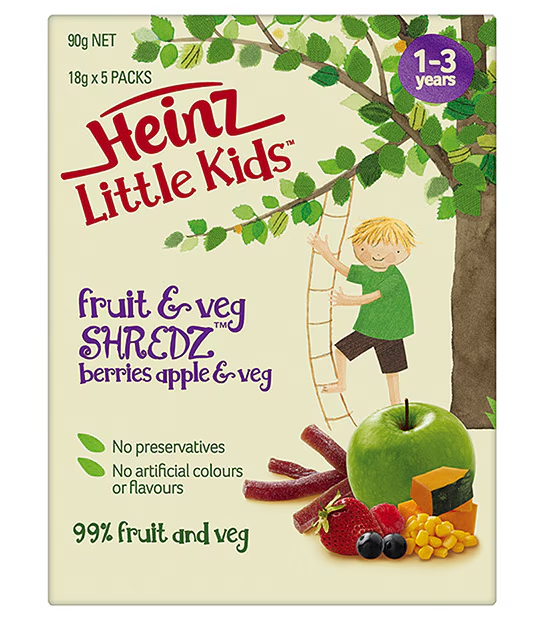
Pictures can speak louder than words. The Federal Court found the fruit and vegetable images on this product, alongside “99% fruit and veg”, gave a misleading impression that the snack was good for toddlers.
The Food Standards Code also has its own rules. Standard 1.2.2 requires a food’s name to indicate its true nature. This will involve thought around both the technical standard and the overall impression your packaging creates.
Planning a new product name or pack design? Ask us to review it before you print.
7. Can imported food keep its overseas name?
Not automatically. A product may lawfully be called chocolate, jam or ice cream overseas, but it must meet Australian requirements to be sold here under that name.
What if the overseas recipe falls short of Australian standards? What if thousands of labels are already printed? And who pays if the packaging must change?
These issues can involve the Food Standards Code, the Imported Food Control Act 1992 (Cth), supply contracts and consumer law. A name that works overseas may not work here. For more on import labelling traps, see Part 7 of this series on date marking.
8. Why not just do it yourself?
At first glance, naming a food product seems simple. You develop the recipe, choose a name and design the packaging.
But the law is not always black and white. Some names are expressly defined in the Code. Others are caught by different rules. And the outcome may depend on whether you use a particular name, or whether your overall presentation suggests the product belongs in a recognised category.
The key question is not whether a name sounds right. It is whether you are legally entitled to use it. That is worth asking before you invest in packaging, advertising and distribution.
TEN FUN FACTS: DID YOU KNOW FOOD NAMES HAVE RULES?
- Chocolate needs cocoa, and lots of it. Food sold as chocolate must be made from at least 20% cocoa bean derivatives.
- Vegetable oil is on a strict ration. Chocolate can contain no more than 5% edible oils other than cocoa butter or dairy fats.
- Peanut butter is (mostly) peanuts. Food sold as peanut butter must contain at least 85% peanuts.
- Strawberry jam must be serious about strawberries. If a fruit is named on the label, the jam must be made from at least 40% of that fruit.
- Marmalade is not jam. The Code’s definition of jam includes conserve but specifically excludes marmalade.
- Ice cream is at least 10% milk fat. Anything less can’t be sold as ice cream, however creamy it tastes.
- Honey has a moisture limit. Food sold as honey must meet minimum sugar and maximum moisture levels.
- Your sandwich is quietly fortified. In Australia, bread-making flour must contain added folic acid, and bread must be made with iodised salt.
- A yellow lid went to court. Kraft peanut butter has been sold here since 1935, but in 2020 the Full Federal Court confirmed Bega owned its famous yellow-lid packaging look.
- A picture can cost millions. Fruit and vegetable images on a toddler snack helped land Heinz a $2.25 million penalty.
Can I call my product chocolate if it contains vegetable oil? Only within strict limits.
Food sold as chocolate must meet Standard 2.10.4, which caps edible oils other than cocoa butter and dairy fats.
Can a plant-based frozen dessert be called ice cream?
Generally not under the ice cream standard, which requires a minimum level of milk fat. The name and packaging must also avoid misleading consumers.
Is a reduced-sugar fruit spread a jam?
Not necessarily. Jam must meet minimum water-soluble solids and fruit content requirements under Standard 2.3.2.
Does choosing a different name solve the problem?
Not always. Images, colours and marketing language can still create a misleading overall impression under the Australian Consumer Law.
Can imported food use its overseas product name?
Only if it meets Australian requirements for that name. Check the composition before you print labels.
Key takeaways
- Many everyday food names have specific legal meanings in Australia.
- Chocolate, jam, ice cream, peanut butter and honey all have compositional requirements.
- Names and packaging must comply with both the Food Standards Code and the Australian Consumer Law.
- Images and overall presentation matter, not just the product name.
- Imported foods must meet Australian standards to use the same name.
- Get legal and technical advice before you commit to a name or pack design.
Final thoughts: turning legalese into legal ease®
Sometimes the biggest legal issue with a food product is not what’s inside the packaging. It’s what you decided to call it.
Talk to us
Sharon Givoni Consulting advises food manufacturers, importers and brand owners on food labelling, packaging, product names and claims, regulatory compliance and the Australian Consumer Law. We help clients spot legal issues before products are launched, reformulated or brought into Australia.
Get in touch: info@iplegal.com.au
- Food Law Series Part 1: Food Law 101: How Is Food Regulated in Australia?
https://sharongivoni.com.au/food-law-series-part-1-food-law-101/ - Food Law Series Part 2: Therapeutic Goods Law 101
https://sharongivoni.com.au/food-law-series-part-2-therapeutic-goods-law-101/ - Food Law Series Part 3: Food or Medicine? Where Is the Line?
https://sharongivoni.com.au/food-law-series-part-3-food-or-medicine - Food Law Series Part 4: Health Claims on Food: The Basics
https://sharongivoni.com.au/food-law-series-part-4-health-claims-on-food-the-basics/ - Food Law Series Part 5: Food law series – A Spritz Too Far?
https://sharongivoni.com.au/food-law-series-part-5-food-law-series-a-spritz-too-far - Food Law Series Part 6: May Contain Traces Of…”: The Allergen Warning That Isn’t Mandatory
https://sharongivoni.com.au/food-law-series-part-6-may-contain-traces-of-the-allergen-warning-that-isnt-mandatory - Food Law Series Part 7: Turning Legalese into Legal Ease
https://sharongivoni.com.au/food-law-series-part-7-turning-legalese-into-legal-ease - Food Law Series Part 9: TBC
- Food Law Series Part 10: TBC
Laws and cases referred to
- Food Standards Australia New Zealand Act 1991 (Cth)
- Australia New Zealand Food Standards Code — Standard 1.1.1 (Structure of the Code and general provisions)
- Australia New Zealand Food Standards Code — Standard 1.1.2 (Definitions used throughout the Code)
- Australia New Zealand Food Standards Code — Standard 1.2.2 (Food identification)
- Australia New Zealand Food Standards Code — Standard 1.2.10 (Characterising ingredients and components of food)
- Australia New Zealand Food Standards Code — Standard 2.1.1 (Cereal and cereal products)
- Australia New Zealand Food Standards Code — Standard 2.3.2 (Jam)
- Australia New Zealand Food Standards Code — Standard 2.5.6 (Ice cream)
- Australia New Zealand Food Standards Code — Standard 2.8.2 (Honey)
- Australia New Zealand Food Standards Code — Standard 2.10.4 (Miscellaneous standards for other foods, including chocolate and peanut butter)
- Competition and Consumer Act 2010 (Cth), Schedule 2 (Australian Consumer Law), sections 18 and 29
- Imported Food Control Act 1992 (Cth)
- Food Act 1984 (Vic), together with corresponding state and territory food legislation
- Australian Competition and Consumer Commission v H.J. Heinz Company Australia Ltd [2018] FCA 360; (No 2) [2018] FCA 1286 (penalty)
- Kraft Foods Group Brands LLC v Bega Cheese Ltd [2020] FCAFC 65
Please note the above article is general in nature and does not constitute legal advice.
Please email us info@iplegal.com.au if you need legal advice about your brand or another legal matter in this area generally.