






Credits: Simon Gagner (Unsplash)
How much talent do you need?
If you’ve ever looked at one of your paintings, patterns or logos and thought, “It’s only a few brushstrokes” or “It’s probably too simple to be protected,” you’re certainly not alone.
In fact, it’s a misconceptions I often come across as an intellectual property lawyer.
Here’s the good news: Australian copyright law doesn’t ask whether your work is clever enough, complicated enough or worthy of hanging in a gallery.
It asks a much simpler question.
Did it come from you?
Not copied. Not traced. Not pieced together from someone else’s work.
Yours.
That’s wonderful news for creatives because so much of what makes your work special isn’t complexity at all. It’s the tiny decisions nobody else would have made quite the same way.
The shade of coral you chose instead of pink.
The shell you painted just slightly off-centre.
The loose watercolour edge that couldn’t have happened any other way.
The way you balanced the pattern across the page until it finally felt right.
Those choices matter.
Legally, they’re often exactly what copyright protects.
One of the things I love about creative businesses is that no two artists see the world in quite the same way. You could hand ten illustrators the same bunch of lemons and ask them to paint them. By the end of the day you’d have ten completely different artworks.
Not because lemons are original.
Because people are and how they portray things visually.
Australian copyright law reflects that idea.
Section 32 of the Copyright Act 1968 (Cth) protects original artistic works. “Original” doesn’t mean revolutionary. It doesn’t mean nobody has ever painted a flower, a shell or a stripe before.
It simply means the work originated from the author through their own intellectual effort, skill and creative judgment.
The High Court reinforced this in IceTV Pty Ltd v Nine Network Australia Pty Ltd (2009) 239 CLR 458. The case wasn’t about artwork at all—it concerned television program schedules. IceTV had used information from Nine’s weekly television guides to produce its own electronic TV guide, and Nine argued that its program schedules were protected by copyright. In deciding the case, the High Court explained that copyright does not simply reward the time, labour or expense involved in creating something. Instead, it protects an author’s own independent intellectual effort and creative choices. That principle applies equally to artists and surface designers. Your pattern isn’t protected because you spent three days painting it; it’s protected because of the creative decisions you made about the motifs, colours, spacing, scale and composition that make it your own. If you’d like to read the High Court’s decision for yourself, you can find it on AustLII here: *IceTV Pty Ltd v Nine Network Australia Pty Ltd* [2009] HCA 14
More weight is given to creative choices and that explains why a beautifully simple design can sometimes enjoy copyright protection.
Australian courts have recognised that originality can exist even where a work is made from ordinary or simple elements. In S W Hart & Co Pty Ltd v Edwards Hot Water Systems (1985) 159 CLR 466, the dispute concerned engineering drawings for hot water systems. The High Court held that copyright protected the author’s skill and judgment in creating the drawings, rather than merely the time spent producing them.
In Elwood Clothing Pty Ltd v Cotton On Clothing Pty Ltd (2008) 80 IPR 565, the dispute involved graphic artwork used on clothing. The Federal Court accepted that even relatively simple graphic designs could qualify as original artistic works for copyright purposes where they reflected genuine creative choices.
You can read the cases here:
S W Hart & Co Pty Ltd v Edwards Hot Water Systems (1985) 159 CLR 466:
https://www.austlii.edu.au/cgi-bin/viewdoc/au/cases/cth/HCA/1985/84.html
Elwood Clothing Pty Ltd v Cotton On Clothing Pty Ltd (2008) 80 IPR 565:
https://www.austlii.edu.au/cgi-bin/viewdoc/au/cases/cth/FCA/2008/447.html
If you’re building a creative business, copyright can be one of your most valuable assets.
At Sharon Givoni Consulting, we help artists, designers and creative businesses protect and commercialise their intellectual property in plain English—turning legal ease into practical advice.

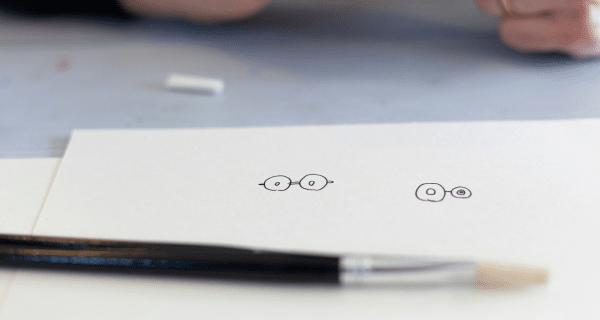
A simple design can still embody originality. In copyright law, it’s the creative choices behind the work that matter. Image Credit: Christopher Stites (Unsplash)
Please note the above article is general in nature and does not constitute legal advice.
Please email us info@iplegal.com.au if you need legal advice about your brand or another legal matter in this area generally.