





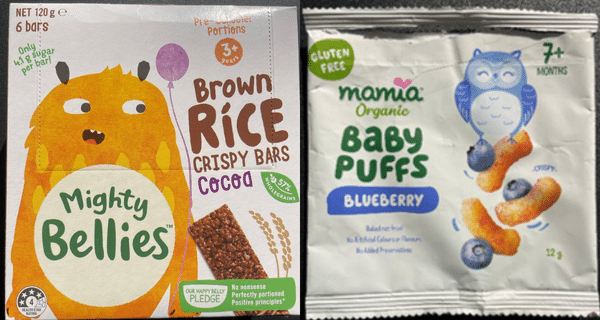

Baby Bellies packaging (left) compared with Aldi’s Mamia Baby Puffs packaging (right). Source: Images reproduced in Aldi Foods Pty Limited v Hampden Holdings I.P. Pty Limited [2026] FCAFC 103, Full Federal Court of Australia.
Dupes, Copycats and Lookalike Packaging: How Close Is Too Close?
Aldi’s latest copyright battle shows that taking inspiration from a competitor’s packaging can sometimes go too far.
WHO SHOULD READ THIS?
This article is particularly relevant to:
- businesses developing new products or packaging;
- brand owners concerned about copycats;
- designers and creative agencies;
- marketing teams preparing creative briefs; and
- businesses that have received a complaint or letter of demand about their packaging.
Dupes are everywhere.
Beauty brands have them. Fashion has them. Supermarket shelves are full of them. Social media has even made finding the cheaper version of an expensive product something of a sport.
And there is nothing inherently unlawful about making a cheaper product that does the same job as somebody else’s.
The legal problems usually start when the similarities go further.
Can you use similar colours? A similar layout? The same style of illustration? What if you change the logo? What if everybody knows yours is simply the cheaper version anyway?
Australia does not have one specific “anti-dupe” law. Instead, copyright, trade marks, registered designs, the Australian Consumer Law and passing off can all come into play.
A recent Aldi case provides a very good example of where the line can be drawn.
Aldi and Baby Bellies: when the “benchmark” gets too close

Baby Bellies Organic Blueberry Puffs — one of the packaging designs at the centre of the copyright dispute. Source: Image reproduced in Aldi Foods Pty Limited v Hampden Holdings I.P. Pty Limited [2026] FCAFC 103, Full Federal Court of Australia.
The dispute began in Hampden Holdings I.P. Pty Ltd v Aldi Foods Pty Ltd [2024] FCA 1452.
Hampden owns intellectual property associated with the Baby Bellies, Little Bellies and Mighty Bellies children’s snack ranges. It claimed that packaging developed for Aldi’s competing Mamia range copied copyright-protected artwork used on its products.
What made the case particularly interesting was the evidence about how Aldi’s packaging had been developed.
The Bellies products had been given to Aldi’s designers as a “benchmark”. There were instructions to “follow the architecture” of the Bellies packaging and feedback that one proposed design was “too close to our benchmark”.
The Full Federal Court later described what had happened in fairly direct terms:
“Rather than undertake its own independent design process, Aldi set out to obtain the benefit of somebody else’s intellectual and creative effort.” (Aldi Foods Pty Limited v Hampden Holdings I.P. Pty Limited [2026] FCAFC 103 at [14])
At the same time, Aldi was trying to remain on the “right side of the line” and avoid legal liability.
That is what makes the decision particularly relevant to businesses developing lookalike products. Aldi was not simply photocopying somebody else’s packet. It was trying to create something similar without going too far.
The problem was that the Court ultimately found it had gone too far.
SEE THE DIFFERENCE FOR YOURSELF

Examples of Baby Bellies packaging and Aldi’s Mamia packaging considered by the Full Federal Court in Aldi Foods Pty Limited v Hampden Holdings I.P. Pty Limited [2026] FCAFC 103. Source: Federal Court of Australia.
The products are not identical. The brands and characters differ, as do some of the words and individual design details.
But copyright infringement does not require an exact copy.
Copyright: changing a few things may not be enough
Under the Copyright Act 1968 (Cth), original artwork can be protected automatically. There is no Australian copyright registration system.
That protection can extend to artwork used on packaging, including illustrations, graphics and other original creative material.
The important distinction is between an idea and the particular way that idea has been expressed.
As the High Court explained in IceTV Pty Ltd v Nine Network Australia Pty Ltd [2009] HCA 14:
“Copyright protects the particular form of expression…” (IceTV Pty Ltd v Nine Network Australia Pty Ltd [2009] HCA 14 at [28])
So nobody owns the idea of using lemons on lemon cider, a cow on milk packaging or a playful character on children’s snacks.
But the particular artwork and creative arrangement may be protected.
It is also not enough simply to make a few changes to the original.
In the Aldi appeal, the Full Court said:
“the fact that the alleged infringer has made some changes to the appropriated part does not necessarily immunise that person from a finding of infringement.” (Aldi Foods Pty Limited v Hampden Holdings I.P. Pty Limited [2026] FCAFC 103 at [83])
The Court explained that similarities can include “style, technique, colour, and visual or design elements”. (Aldi Foods Pty Limited v Hampden Holdings I.P. Pty Limited [2026] FCAFC 103 at [85])
The question is whether what has been taken amounts to a substantial part of the original copyright work.
And “substantial” is not simply about quantity.
As the High Court put it:
“the quality of what is copied is critical.” (IceTV Pty Ltd v Nine Network Australia Pty Ltd [2009] HCA 14 at [30])
But you cannot copyright a “vibe”

Mighty Bellies Brown Rice Crispy Bars — another of the Bellies packaging designs considered in the case. Source: Image reproduced in Aldi Foods Pty Limited v Hampden Holdings I.P. Pty Limited [2026] FCAFC 103, Full Federal Court of Australia.
There is an important limit.
Copyright does not allow a business to own an entire aesthetic or style.
The Full Court made this particularly clear:
“Copyright does not protect a style or get-up. Copyright protects a particular form of expression…” (Aldi Foods Pty Limited v Hampden Holdings I.P. Pty Limited [2026] FCAFC 103 at [104])
So a brand cannot simply claim ownership of a “natural”, “luxury”, “playful” or “minimalist” look.
The question is what particular creative material has actually been copied.
Aldi appealed — and went “slightly backwards”
At first instance, Justice Moshinsky found that three Aldi packaging works infringed Hampden’s copyright and that Aldi’s conduct was “flagrant”.
Aldi appealed. Hampden cross-appealed over products that had been found not to infringe.
The Full Court disagreed with parts of the original reasoning, but ultimately found infringement in relation to a broader group of Aldi works.
The Court rather dryly observed that Aldi had:
“gone slightly backwards overall.” (Aldi Foods Pty Limited v Hampden Holdings I.P. Pty Limited [2026] FCAFC 103 at [240])
It also left the order for additional damages in place.
The reason is worth noting.
The Court said Aldi had “deliberately courted a risk while seeking to obtain a commercial advantage” and added:
“Aldi could have used any packaging of its own design, but chose to emulate the Hampden Works for its own benefit.” (Aldi Foods Pty Limited v Hampden Holdings I.P. Pty Limited [2026] FCAFC 103 at [120])
The warning for other businesses was clear:
“If Aldi chooses to conduct its business in that manner, it runs the risk that infringement will lead to additional damages.” (Aldi Foods Pty Limited v Hampden Holdings I.P. Pty Limited [2026] FCAFC 103 at [120])
In other words, deliberately sailing close to the legal line carries a risk that you may misjudge where that line actually is.
Trade marks: protecting more than the name
Copyright is only one way to protect packaging. Trade mark law can also help.
Under the Trade Marks Act 1995 (Cth), registered trade marks such as brand names and logos can be protected from use by competitors. In some circumstances, distinctive shapes, colours or other aspects of packaging can also function as trade marks.
An early Aldi case shows why the particular legal right matters.
In Aldi Stores Ltd Partnership v Frito-Lay Trading Company GmbH [2001] FCA 1874, Frito-Lay argued that Aldi’s CHEEZY TWISTS infringed its TWISTIES trade mark.
Frito-Lay won at first instance, but Aldi won on appeal.
Importantly, the appeal concerned trade mark infringement. It was not a broader case about whether Aldi had copied the overall look of the packaging.
A business may feel that a competitor has copied “everything”, but legally the question is: what exactly has been copied and what right protects it?
The Australian Consumer Law: what will shoppers think?
The Australian Consumer Law can also apply to lookalike packaging.
Section 18 prohibits misleading or deceptive conduct. Other provisions can apply where packaging makes false claims about a product, its origin or its connection with another business.
The question is different from copyright.
Rather than simply asking whether artwork has been copied, the focus is on what impression the packaging gives consumers.
Does it suggest that the products come from the same company? That the brands are connected? Or that the original brand has approved or endorsed the product?
That can make some dupe cases difficult where shoppers know perfectly well that they are buying a cheaper alternative.
Moroccanoil: similarity alone wasn’t enough
That distinction can be seen in Moroccanoil Israel Ltd v Aldi Foods Pty Ltd [2017] FCA 823 and the appeal, Aldi Foods Pty Ltd v Moroccanoil Israel Ltd [2018] FCAFC 93.
The dispute involved Aldi’s Moroccan Argan Oil haircare range and the established Moroccanoil products.
There were obvious similarities in their presentation, including the turquoise and brown colour combination.
But similarity alone did not decide the case. The proceedings involved trade mark and Australian Consumer Law issues, including what consumers would actually understand from the packaging.
It demonstrates a simple but important point:
“They copied our look” is not, by itself, a legal claim.
You still need to identify what legal right has been infringed.
Passing off
Passing off can apply where a business presents its products in a way that wrongly suggests a connection with another brand.
However, if the copycat has its own clear branding and shoppers understand that it is simply a cheaper alternative, this type of claim can be harder to prove.
That does not necessarily mean the copying is lawful. Copyright, trade mark or design law may simply provide a better claim.
Registered designs: think about protection early
The Designs Act 2003 (Cth) provides another way of protecting certain visual features of products.
The important point is to think about design protection early.
If you have invested significantly in the distinctive appearance of a product or its packaging, consider what can be protected before going to market rather than waiting until a copycat appears.
Thatchers v Aldi: another dupe battle
The problem is certainly not confined to Australia.
In Thatchers Cider Company Limited v Aldi Stores Limited [2025] EWCA Civ 5, the UK Court of Appeal considered Aldi’s Taurus Cloudy Lemon Cider packaging, which resembled the well-known Thatchers Cloudy Lemon Cider packaging.
Again, Aldi had used the competitor’s product as a “benchmark”.
The Court found that Aldi had taken unfair advantage of the reputation of Thatchers’ registered trade mark.
Lord Justice Arnold said:
“The inescapable conclusion is that Aldi intended the Sign to remind consumers of the Trade Mark.” (Thatchers Cider Company Limited v Aldi Stores Limited [2025] EWCA Civ 5 at [115])
Importantly, Thatchers did not need to prove that shoppers actually believed Aldi’s cider was a Thatchers product.
So “nobody thought it was the real thing” will not necessarily answer every IP claim.
Charlotte Tilbury takes on an Aldi beauty dupe
Aldi has also faced a similar fight in the beauty aisle.
In Islestarr Holdings Ltd v Aldi Stores Ltd [2019] EWHC 1473 (Ch), the company behind Charlotte Tilbury successfully sued over Aldi’s lookalike Broadway Shape and Glow makeup palette.
Copyright was important because protected artistic elements of the original design had been copied.
Again, it did not necessarily matter that shoppers knew they were buying Aldi rather than Charlotte Tilbury. Copyright asks a different question: has protected creative material been copied?
Be careful with “benchmarking”
There is nothing wrong with researching competitors.
Businesses need to know what is already on the market and designers need to understand the category they are working in.
The danger is allowing one competitor’s product to become the blueprint.
There is a considerable difference between saying:
“Here are ten competing products. Look at the market and create something original for us.”
and:
“This is the market leader. Use this as the benchmark. Follow its layout, but make ours different enough.”
The Bellies case also shows that the court may look beyond the finished product.
Emails, design briefs, mood boards, presentations, WhatsApp messages and earlier drafts can all become evidence of how the design was developed.
A good rule is simple: know what your competitors are doing, but create your own look.
COPYCAT PACKAGING: 7 THINGS TO KNOW
- There is no single Australian “anti-dupe” law.
Copyright, trade marks, designs, the Australian Consumer Law and passing off may all apply. - Copyright protection is automatic in Australia.
Original artwork does not need to be registered. - Changing the logo may not be enough.
Other artwork and design elements may still raise copyright issues. - You cannot own a general style or “vibe”.
Copyright protects particular creative expression. - Consumer confusion is not always necessary.
Different legal claims ask different questions. - Benchmarking competitors can be risky.
Research the market, but don’t use one competitor as the blueprint for your design. - Your emails may become evidence.
Creative briefs, drafts and internal messages can later help show how and why a design was created.
Before you launch — or after a copycat appears
Packaging disputes are much easier to deal with before thousands of products have been manufactured, printed and distributed.
Sharon Givoni Consulting advises businesses on copyright, trade marks, designs, branding, packaging and the Australian Consumer Law.
We can review packaging before launch, advise on protecting distinctive branding and artwork, assess whether a competitor has copied too much, and assist with letters of demand and packaging disputes.
The best time to find out that your packaging is too close to somebody else’s is before it reaches the shelf.
Further Reading
Maltesers Take on Malt Balls Over Their Packaging — Sharon Givoni Consulting
https://sharongivoni.com.au/maltesers-take-on-malt-balls-over-their-packaging/?utm_source=chatgpt.com
Inspiration… or Rip Off? When Does Inspiration Become Copying in Branding, Packaging and Product Design? — Sharon Givoni Consulting
https://sharongivoni.com.au/inspiration-or-rip-off/?utm_source=chatgpt.com
Product Packaging and the Law: What’s Fair Game? — Sharon Givoni Consulting
https://sharongivoni.com.au/product-packaging-and-the-law-whats-fair-game/?utm_source=chatgpt.com
Aldi is known for drawing inspiration from big brands. Here’s how experts say the retailer does it — ABC News
https://www.abc.net.au/news/2025-06-07/court-case-puts-aldi-branding-and-packing-under-microscope/105386258?utm_source=chatgpt.com
Aldi liable for ‘flagrant’ copyright breach of rival brand’s packaging, Australian federal court finds — The Guardian
https://www.theguardian.com/business/2024/dec/19/aldi-copyright-breach-baby-bellies-designs-australia-court-ntwnfb?utm_source=chatgpt.com
Please note the above article is general in nature and does not constitute legal advice.
Please email us info@iplegal.com.au if you need legal advice about your brand or another legal matter in this area generally.