





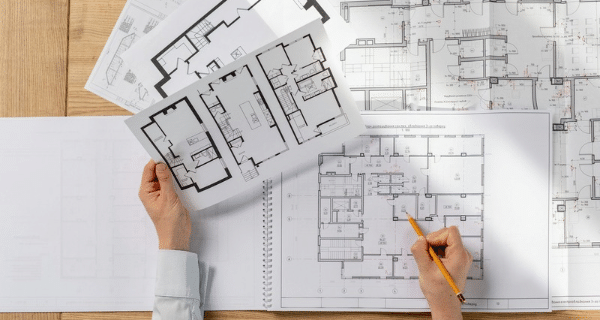

Photo by Getty Images on Unsplash
Part 7 of our Architectural Copyright Series
House plans, copied designs – Why a legal letter isn’t the final word.
Did you get a letter of demand about copyright?
WHO SHOULD READ THIS?
This article is for homeowners, builders, architects, building designers, developers and company directors who have received a copyright infringement letter of demand concerning house plans, architectural drawings or building designs.
It is also relevant to anyone who believes their own architectural work has been copied and is considering taking legal action.
A letter arrives. Suddenly, your dream home has a legal problem.
Imagine opening your email to discover that someone is accusing you of copyright infringement.
Perhaps you built your dream home several years ago. Perhaps you’re a builder who has used a set of plans supplied by a client. Or maybe you’re a property developer who has just received a letter demanding compensation for allegedly copying another company’s design.
The letter might demand thousands of dollars, copies of your building plans, an undertaking to stop construction or a response within seven days.
It might even threaten Federal Court proceedings.
Understandably, your first reaction may be panic. Your second might be to Google the allegations and see whether the law is really as serious as the letter suggests.
We regularly encounter copyright questions involving architectural plans, building designs and allegations of copying. One of the biggest misconceptions is that receiving a legal letter means the sender must be right.
It doesn’t.
But ignoring the letter, making assumptions about your rights or sending an angry response can create its own problems.
Australian courts have considered some remarkable disputes involving homeowners, builders and architectural designs. Some claims have succeeded, others have failed, and the consequences have sometimes been expensive.
The important thing to understand is that these disputes are rarely black and white.
What do Australian copyright cases tell us?
Four Australian decisions illustrate why a copyright allegation involving house plans should never be taken at face value.

Two views of a modern home – but when do similarities between architectural designs become a copyright issue? | Photo by Archidea from unsplash
When homeowners and builders were both held responsible
In Henley Arch Pty Ltd v Lucky Homes Pty Ltd [2016] FCA 1217, a dispute arose after homeowners decided not to proceed with their original builder and instead engaged another company to construct a home based on a similar design.
The Federal Court found that copyright had been infringed. The builder, its director and the homeowners were held liable.
The Court awarded over $30,000 in damages, together with additional damages of $25,000 against the builder and its director and $10,000 against one homeowner.
WHAT ARE ADDITIONAL DAMAGES?
Additional damages are amounts a court can award on top of ordinary compensation for copyright infringement.
They may be awarded where the conduct is particularly serious or deliberate, or where the Court considers that an extra amount is needed to deter similar behaviour.
In this case, the Court awarded $25,000 against the builder and its director, and $10,000 against one homeowner, in additional damages.
The case raises a question that surprises many people: can an ordinary homeowner become personally liable for copyright infringement involving plans used by their builder?
The answer depends on the circumstances, including the homeowner’s conduct, the source of the plans and the involvement of the various parties.
The case also involved allegations concerning representations made about how many changes could be made to a design to avoid infringement.
It is a reminder that apparently reassuring statements about copyright may prove expensive if they are legally incorrect.
Can changing builders turn into a copyright dispute?
Sometimes, yes.
In Look Design and Development Pty Ltd v Edge Developments Pty Ltd & Flaton [2022] QDC 116, homeowners had received plans from one building company before engaging another builder.
The second builder settled the dispute for $30,000. The homeowners proceeded to trial, where the Queensland District Court found that they had authorised infringement.
Although the damages ultimately ordered against the homeowners were relatively modest, the litigation raised broader questions about responsibility for the use of architectural plans.
What if a homeowner supplies drawings merely to show another builder the kind of house they want?
What if the new builder prepares fresh drawings?
And what if everyone believes the changes are sufficient?
These questions can involve far more than comparing two floor plans. The communications, instructions and agreements between the parties may become critical.
Changes required to a completed house
Perhaps one of Australia’s most striking architectural copyright cases is Coles v Dormer & Ors [2015] QSC 224.
The dispute involved two houses in the same Port Douglas estate.
After missing out on purchasing a distinctive property, another couple engaged the builders of that house to construct a similar residence nearby.
The new owner of the original property had acquired copyright in the architectural plans and objected to the proposed replica.
The dispute went to court.
The Supreme Court of Queensland found infringement and ordered alterations to the exterior of the second house, including its dormer roofs and distinctive architectural features.
Imagine being told that parts of your completed home must be changed because of copyright infringement.
It sounds extraordinary, but the decision demonstrates the potentially serious consequences of architectural copyright disputes.
Importantly, it does not mean that demolition or alteration orders are inevitable whenever infringement is established. The remedies depend on the particular facts and the Court’s assessment.
When the builder accused of copying won
Not every copyright claim succeeds.
In Inform Design and Construction Pty Ltd v Boutique Homes Melbourne Pty Ltd [2008] FCA 912, Inform Design alleged that Boutique Homes had copied its residential designs.
The Federal Court considered evidence concerning the similarities between the plans and how the competing designs had been developed.
Ultimately, the Court accepted evidence of independent creation and dismissed the infringement claim.
The unsuccessful claimant was ordered to pay costs.
This case is particularly important because it demonstrates that similarities between buildings do not automatically establish copying.
It also raises an interesting question: how can two designs look remarkably similar without infringement? The answer may depend on the design history, the evidence and the legal principles governing copyright. Taken together, these four decisions demonstrate why architectural copyright disputes can produce very different outcomes.
Common questions
I’ve received a copyright infringement letter. Does that mean I’m guilty?
No. A letter of demand is an allegation, not a court judgment.
Generally, Australian copyright law protects original architectural drawings and certain architectural works. However, establishing infringement may involve questions about copyright ownership, originality, copying, substantial reproduction and permission.
The sender’s interpretation of the facts may be disputed and as lawyers, we would carefully assess the allegations and the available evidence before advising.
The house was built years ago. Can someone still sue me?
Possibly.
Section 134 of the Copyright Act 1968 (Cth) generally imposes a six-year limitation period for infringement proceedings.
However, determining when time begins to run can become complicated, particularly where different acts are alleged to have occurred at different times.
The date of construction may not necessarily resolve every issue.
A lawyer can assess the relevant conduct and dates to determine whether a limitation defence may be available.
My house only looks a little similar. Isn’t that just an architectural style?
Good question. Copyright generally protects the expression of an idea rather than the idea itself.
Architectural styles such as Hamptons, contemporary, Mediterranean or minimalist are not automatically owned by one designer.
However, the distinction between a general style and protected expression can be difficult.
The High Court’s decision in IceTV Pty Limited v Nine Network Australia Pty Limited [2009] HCA 14; (2009) 239 CLR 458 discusses important principles concerning originality and substantial reproduction. Architectural cases such as Tamawood Limited v Henley Arch Pty Ltd [2004] FCAFC 78; (2004) 61 IPR 378 demonstrate how challenging those principles can be when applied to residential designs.
We changed the plans. Surely that makes them different?
Here’s the thing – there is no general rule that changing 10%, 20% or any other fixed percentage of a work avoids copyright infringement.
Section 14 of the Copyright Act 1968 (Cth) addresses the reproduction of a substantial part of a work.
The decisions in Metricon Homes Pty Ltd v Barrett Property Group Pty Ltd [2008] FCAFC 46 and LED Builders Pty Ltd v Eagle Homes Pty Ltd (1996) 35 IPR 215 illustrate why differences between architectural plans do not necessarily dispose of infringement allegations.
But the opposite is also true: similarities do not automatically establish liability. The assessment requires consideration of the particular designs and the circumstances in which they were created.

Architectural drawings can reveal how a building’s design has evolved over time. | Photo by Amsterdam City from unsplash
We never saw the other builder’s plans. Doesn’t that settle it?
Not necessarily, although being able to prove independent creation can be highly significant. Copyright infringement generally requires a relevant connection between the earlier protected work and the allegedly infringing work.
A lawyer may need to examine the complete history of a design before assessing the allegation.
I’m only the homeowner. Why am I being sued?
This is something that surprises many homeowners. They often assume that if there is a copyright problem with their house plans, it is the builder’s responsibility.
However, under section 36 of the Copyright Act 1968 (Cth), you can sometimes be responsible for copyright infringement even if you didn’t do the copying yourself, but allowed or encouraged someone else to do it.
The Henley Arch and Look Design cases show that homeowners can also be held responsible, not just builders.
Much depends on what the homeowner knew, what they did and what they agreed to. Every case is different.

A completed home can still become the subject of a copyright dispute. | Photo by Getty Images from unsplash
I’m a company director. Can I be personally liable?
This is something that surprises many homeowners. They often assume that if there is a copyright problem with their house plans, it is the builder’s responsibility.
However, under section 36 of the Copyright Act 1968 (Cth), you can sometimes be responsible for copyright infringement even if you didn’t do the copying yourself, but allowed or encouraged someone else to do it.
The Henley Arch and Look Design cases show that homeowners can also be held responsible, not just builders.
Much depends on what the homeowner knew, what they did and what they agreed to. Every case is different.
I’m a company director. Can I be personally liable?
Yes, company directors can sometimes be personally responsible for copyright infringement, even when acting through a company.
The Henley Arch case shows that directors can be held liable if they are personally involved in the infringement. It depends on what you actually did.
Do I have to provide every document demanded in the letter?
Not necessarily. A letter of demand does not, by itself, have the same compulsory effect as a court order.
However, contractual obligations, pre-action procedures, formal court processes or other circumstances may affect what information must be provided and when.
There may also be questions about confidentiality, privilege and the preservation of relevant evidence.
Can they force me to stop building or change my house?
Potentially, yes. Under section 115(2) of the Copyright Act 1968 (Cth), courts can award compensation, order someone to stop infringing copyright and, in some cases, even require changes to a building. In Coles v Dormer, the Court ordered alterations to a house because of copyright infringement.
Should I just pay the amount demanded to make the problem disappear?
Sometimes, settling a copyright dispute is the quickest and cheapest option.
However, the amount demanded in a letter is not necessarily what you legally owe.
Before agreeing to pay, it is important to check whether the claim is valid, whether the amount is reasonable and whether the settlement will bring the dispute to an end.
A quick settlement can become expensive if it leaves you open to further claims.
Legal advice can help assess both the claim and the commercial implications of settlement.
What does Australian copyright law actually say?
The principal legislation is the Copyright Act 1968 (Cth).
Section 10(1) defines artistic works to include drawings and works of architecture. Section 32(2) provides for copyright protection in original artistic works where the statutory requirements are satisfied.
Section 21(3) recognises that reproduction of an artistic work can occur between two-dimensional and three-dimensional forms. This is particularly important where architectural drawings are used to construct buildings.
Section 31(1)(b) identifies the copyright owner’s exclusive rights in artistic works, while section 36(1) addresses infringement and authorisation.
Section 14 deals with the reproduction of a substantial part of a work.
Section 38 concerns certain commercial dealings in infringing articles, subject to specific requirements.
Section 115 addresses remedies, including injunctions, damages, accounts of profits and additional damages. Section 115(3) also deals with innocent infringement in relation to damages.
Section 134 addresses limitation periods.
Finally, section 202 provides a remedy in certain circumstances involving unjustifiable threats of copyright infringement proceedings.
These provisions provide the legal framework, but they do not answer every question.
The difficult part is often applying them to a particular design, contract, building project and set of communications. That is where legal interpretation and evidence become so important.
Why use a copyright lawyer for a house-plan dispute?
It can be tempting to respond to a copyright letter yourself, particularly if you believe the allegations are exaggerated or completely unfounded.
After all, you know what happened. You may have the drawings, emails and contracts. You may even have found an online article describing a court case that sounds remarkably similar to yours.
But knowing the history of a project is not the same as understanding its legal implications.
An experienced copyright lawyer can bring several important perspectives to the dispute.
The letter may not tell the whole story
A letter of demand generally presents one party’s position. It may contain legal assertions, factual allegations and demands that require closer examination.
The relevant evidence may not be obvious
Architectural copyright disputes can involve successive versions of plans, emails, sketches, contracts, instructions and records of how designs developed.
Sometimes a document that appears unimportant to the parties may have considerable legal significance.
Conversely, something that looks decisive at first glance may become less significant when viewed in context.

The history of a design can be just as important as the finished plans. | Photo by Daniel Mccullough from unsplash
Your response can affect what happens next
An early response may influence negotiations, litigation strategy and the way the parties understand the dispute.
There may be risks in making unnecessary admissions, providing incomplete explanations or responding without understanding the applicable legal issues.
A carefully considered legal response can help ensure that the allegations are addressed appropriately.
Litigation is not always the best commercial outcome
Sometimes a dispute can be resolved through negotiation. In other circumstances, court proceedings may become necessary. The appropriate approach depends on the strength of the legal position, the available evidence, the commercial interests involved and the likely costs. A lawyer can help assess these competing considerations.
Even sending a letter of demand carries risks
The law also recognises that allegations of copyright infringement should not be made lightly. Section 202 of the Copyright Act 1968 (Cth) addresses unjustifiable threats of copyright proceedings. For designers and builders who believe their work has been copied, this is another reason to obtain advice before sending an aggressive legal letter. A strong claim should be supported by careful legal analysis rather than assumptions or threats.
The value of legal advice is not simply knowing what the Copyright Act says. It is understanding how the law applies to your particular circumstances, what evidence matters and which course of action is commercially sensible.
Why Google cannot decide your copyright dispute
There is no shortage of information online about copyright infringement.
But it cannot determine who owns the relevant copyright, whether permission existed, what particular communications mean or how a court might assess disputed evidence. The cases discussed in this series demonstrate why apparently similar disputes can have different outcomes.
In Inform Design, the infringement claim failed.
In Henley Arch and Look Design, homeowners were found liable.
In Coles v Dormer, the Court ordered physical changes to a house.
The law did not produce these outcomes merely because one design looked more or less similar to another. Each case involved its own evidence and legal questions.
We can assist you
If you have received a copyright infringement letter of demand, we can examine the allegations, review the relevant documents, advise on your legal position and prepare a response on your behalf. We can also assist with negotiations, settlement discussions and court proceedings where necessary.
For architects and designers who believe their work has been copied, we can advise on the available options and assist with preparing appropriately supported letters of demand.
At Sharon Givoni Consulting, we explain the law in legal ease, not legalese®.
Further Reading
The 10% Copyright Rule Is a Myth
https://sharongivoni.com.au/the-10-copyright-rule-is-a-myth/
What Can Go Wrong If You Send a Copyright or Trade Mark Threat and Not Use a Lawyer?
https://sharongivoni.com.au/what-can-go-wrong-if-you-send-a-copyright-or-trade-mark-threat-and-not-use-a-lawyer/
What Can You Do If Someone Copies Your Work Without Permission?
https://sharongivoni.com.au/what-can-you-do-if-someone-copies-your-work-without-permission/
Who Owns Copyright: Your Employee or Your Contractor?
https://sharongivoni.com.au/who-owns-copyright-your-employee-or-your-contractor/
Beware: Assigning Copyright and Losing Control of Your Work
https://sharongivoni.com.au/beware-assigning-copyright-and-losing-control-of-your-work/
Court Rules Qld Replica Home Must Change – AAP, published by Nine, 6 August 2015.
A news report about the Port Douglas copyright dispute and the court order requiring changes to a replica home.
https://www.nine.com.au/australia-news/qld/court-rules-qld-replica-home-must-change-20150806-p5tfld.html
Special Difficulty: Volume Builders and Copyright in Architectural Plans – Angus Christophersen, Intellectual Property Forum, June 2021.
An academic examination of why project-home copyright cases can be unusually difficult.
https://www.ipsanz.com.au/common/Uploaded%20files/IP%20Forum%20-%20Journal/IPSANZ%20Journal%20124%20%20June%202021.pdf
Building Plans & Copyright – Australian Copyright Council, 1 February 2023.
A specialist fact sheet explaining copyright issues involving architects, builders, draftspeople and clients.
https://www.copyright.org.au/browse/book/ACC-Building-Plans-%26-Copyright-INFO017
Working with an Architect – Australian Institute of Architects.
Covers copyright ownership, moral rights and the relationship between architects and their clients.
https://www.architecture.com.au/explore/working-with-an-architect
Architectural Copyright Series
Architectural Copyright Series Part 1: Architecture and Copyright: Who Owns the Name?
https://sharongivoni.com.au/architectural-copyright-series-part-1-youve-built-an-art-business-but-who-owns-the-name/
Architectural Copyright Series Part 2: Moral Rights in Architecture: Can You Change an Architect’s Design?
https://sharongivoni.com.au/architectural-copyright-series-part-2-moral-rights-in-architecture/
Architectural Copyright Series Part 3: When Does a Similar House Design Become Copying?
https://sharongivoni.com.au/architectural-copyright-series-part-3-when-house-designs-look-alike-what-does-the-law-say/
Architectural Copyright Series Part 4: Can You Take a Builder’s House Plans Elsewhere?
Architectural Copyright Series Part 5: When a Building Project Changes Hands, Who Can Use the Plans?
https://sharongivoni.com.au/architectural-copyright-series-part-5-when-a-building-project-changes-hands-who-can-use-the-plans/
Architectural Copyright Series Part 7: Received a Letter of Demand About Your House Design? What It Means and What Happens Next
https://sharongivoni.com.au/architectural-copyright-series-part-7-received-a-letter-of-demand-about-your-house-design/
Please note the above article is general in nature and does not constitute legal advice.
Please email us info@iplegal.com.au if you need legal advice about your brand or another legal matter in this area generally.